





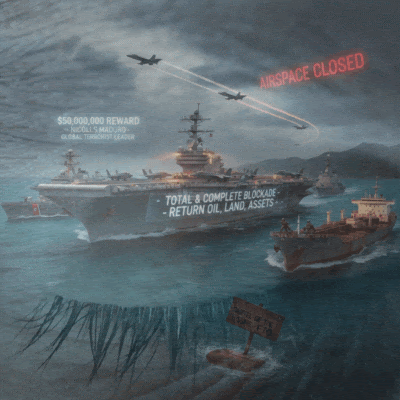

The deployment of a naval armada on December 16, representing approximately fifteen percent of total United States military assets near Venezuela, marks a transition from diplomatic pressure to active kinetic operations.
This massive military presence has severely restricted the options available to President Maduro, who continues to maintain strict control over his nation despite its profound economic challenges. Complementing the naval presence, Venezuelan airspace has remained entirely closed to air traffic since late November.
Recent American operations have focused on intercepting drug trafficking vessels, resulting in the reported elimination of over one hundred narco-terrorists through maritime strikes. Furthermore, the United States has begun seizing tankers transporting sanctioned oil, a move that Venezuela unsuccessfully challenged before the United Nations Security Council.
This maritime strategy also affects China, a primary purchaser of Venezuelan crude, by cutting off a source of inexpensive energy. While both China and Russia have formally condemned these actions and questioned their legal basis, Beijing has yet to deliver a definitive strategic response.
Despite Venezuela holding the largest proven oil reserves in the world, the current crisis has failed to drive up global energy prices. Market analysts suggest that record production levels in Guyana, Brazil, and the United States have created a global surplus that offsets the loss of Venezuelan supply.

Even a reported draw of over one million barrels from American crude stocks, as noted by the American Petroleum Institute and the Energy Information Administration, failed to spark a price rally. This suggests that global energy markets may remain resilient even if the regional situation escalates into open conflict.
On the tactical level, the United States has deployed advanced aircraft including F-18s, F-35 stealth fighters, and specialized electronic warfare platforms. American planners are particularly focused on Venezuela’s possession of five thousand Russian-made man-portable air defence systems. While these missiles pose a threat to helicopters and low-flying planes, they are less effective against high-altitude jets. The recent arrival of HC-130J and Jolly Green rescue helicopters in Puerto Rico suggests that the military is preparing for potential pilot recovery missions rather than scaling back operations.
While Venezuela maintains sophisticated Russian S-300 air defence systems, United States electronic warfare capabilities could potentially neutralize these defences during an engagement. Given that President Maduro has shown no intention of yielding, the standoff appears likely to continue with increasing intensity.
