





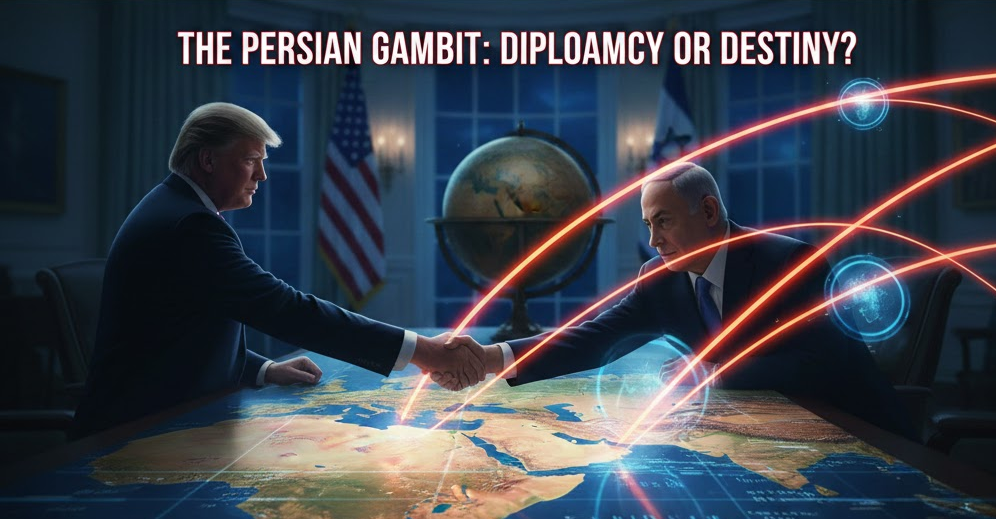

President Trump welcomed Israeli Prime Minister Benjamin Netanyahu to the White House on Wednesday for a high-stakes summit, set against the backdrop of rapidly evolving military escalation in the Middle East.
Following a closed-door session with a select group of officials, President Trump emerged to signal a dual-track approach. He stated that the U.S. remains prepared to give “negotiations” a chance, while pointedly referencing the events of June, when Tehran failed to engage seriously with his previous overtures. Prime Minister Netanyahu remained characteristically tight-lipped as he departed for Israel later that evening.
The diplomatic movement has clearly unsettled Tehran. Iranian officials have made little effort to hide their dismay, fearing that the Israeli leader successfully lobbied for a “military option” to neutralize Iran’s burgeoning ballistic missile program.
The Missile Threat: A Strategic Overview

The technical disparity between regional threats is stark. Unlike cruise missiles, which remain within the atmosphere on airplane-like flight paths, ballistic missiles follow a suborbital trajectory through the upper atmosphere before descending at hypersonic speeds.
An Iranian missile traveling 2,000 km can strike its target in just 10 to 12 minutes. With warheads weighing up to 1,500 kg, these projectiles pose a catastrophic threat unless intercepted by sophisticated defense tiers, such as Israel’s Arrow and David’s Sling, or the U.S. Navy’s Aegis systems.
Experts estimate Iran’s arsenal at over 3,000 ballistic missiles—the largest in the Middle East. With ranges reaching 2,000 km, Tehran can threaten not only Israel but also key U.S. partners including Qatar, the UAE, Jordan, Bahrain, and Saudi Arabia.
Mobility and Vulnerability
To protect this “only reliable defense,” Iran utilizes Transporter Erector Launchers (TELs). These vehicles are often camouflaged as civilian shipping containers or transport trucks to evade satellite detection.
The readiness of these assets depends on their propulsion:
Solid-fuel missiles: Can be deployed from hidden tunnels and launched within minutes.
Liquid-fuel missiles: Require a cumbersome convoy of fuel and oxidizer trucks, making them much easier for adversaries to track.
Despite these precautions, Iran’s launch sites remain vulnerable. If the U.S. and its allies maintain sustained aerial patrols or deploy sophisticated drone swarms, these “silos” can be neutralized. During the “12-Day War” in June, Israeli strikes successfully crippled several launching units, though the bulk of the arsenal remained intact.
The United States is currently surging military hardware into the region on an unprecedented scale. The arrival of a massive fleet of refueling aircraft suggests that Washington is preparing for the possibility of long-range, sustained sorties.
However, the ultimate “X-factor” may not be military, but social. While the recent internal uprisings in Iran have quieted, the resentment remains. Unlike the conflict in June, a direct U.S. intervention could serve as the spark that reignites the Iranian youth, potentially forcing the regime to fight a war on two fronts: one against the world’s most advanced military, and another against its own people.
Whether this is a “great deception” designed to force Iran to the table or a genuine prelude to a strike remains to be seen. But as the refueling tankers touch down and the carrier groups take their positions, one thing is certain: the window for “negotiations” is closing, and the sound of the drums of war is growing louder by the day.
