






The United States and Iran are convening in Geneva, Switzerland, today for a second round of negotiations centered on four core issues. While Iran insists on limiting the agenda to uranium enrichment, the United States and Israel are pushing to include Iran’s ballistic missile program and its support for regional militant groups like Hamas, Hezbollah, and the Houthis. Iran maintains that these additional topics are strict red lines.
Regarding enrichment, President Trump recently stated he opposes Iran maintaining any level of enrichment capabilities. On the military front, the US and Israel seek to cap Iran’s missile range at 300 km, a significant reduction from the current 2000 km. Given Iran’s vast geography—spanning roughly 2000 km in length and 1800 km in width—such a limit would essentially restrict missile flight to within its own borders unless launchers are moved directly to the frontier. Tehran views this as a demand to leave the country strategically exposed, making an agreement highly unlikely.
As both sides remain deadlocked, regional tensions continue to rise. Iranian officials and IRGC members have intensified their rhetoric, threatening cities in the UAE, Bahrain, Qatar, Saudi Arabia, and Jordan, where US bases are located. In response, the US and its allies have deployed numerous air defense systems, including THAAD and Patriot batteries. The significant arrival of US refueling tankers also suggests preparations for sustained aerial operations by US or Israeli fighter jets to monitor and potentially target Iranian missile and drone facilities.
Internal pressure on the Iranian regime is also mounting. A massive diaspora rally in Munich recently showcased strong support for Crown Prince Reza Pahlavi, signaling a unified opposition that has unsettled Tehran. While the streets in Iran are currently quieter due to a heavy crackdown, the spirit of protest remains a dormant force waiting for a new spark.
This friction is felt most acutely in the Strait of Hormuz, where the US Maritime Administration has warned commercial vessels to avoid Iranian waters. Tankers have begun increasing speeds to minimize exposure as the threat of seizures looms. Because this chokepoint handles roughly 20% of global oil consumption, markets are on edge. While Brent crude has hovered around $68 per barrel, the arrival of more naval assets this weekend could rapidly inflate the “war premium,” with analysts warning of a spike toward $91 if disruptions occur.

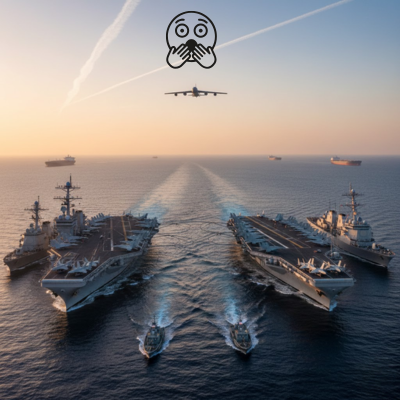
The military landscape is becoming increasingly crowded. The USS Abraham Lincoln strike group, featuring Carrier Air Wing 9 and three Arleigh Burke-class destroyers—the USS Spruance, USS Michael Murphy, and USS Frank E. Petersen Jr.—is already operating in the Arabian Sea. They are being joined by the world’s largest warship, the USS Gerald R. Ford, creating a rare dual-carrier presence. On the other side, the IRGC Navy has initiated “Smart Control” drills in the Strait, deploying fast attack craft, drones, and electronic warfare units designed for asymmetric confrontation.
The stage is set for a pivotal and highly volatile week. Time will tell if these diplomatic efforts can bridge such a vast divide or if the gathering clouds in the region signal a different path ahead. Whatever the outcome, the eyes of the world remain fixed on Geneva and the vital waters of the Arabian Sea.
