





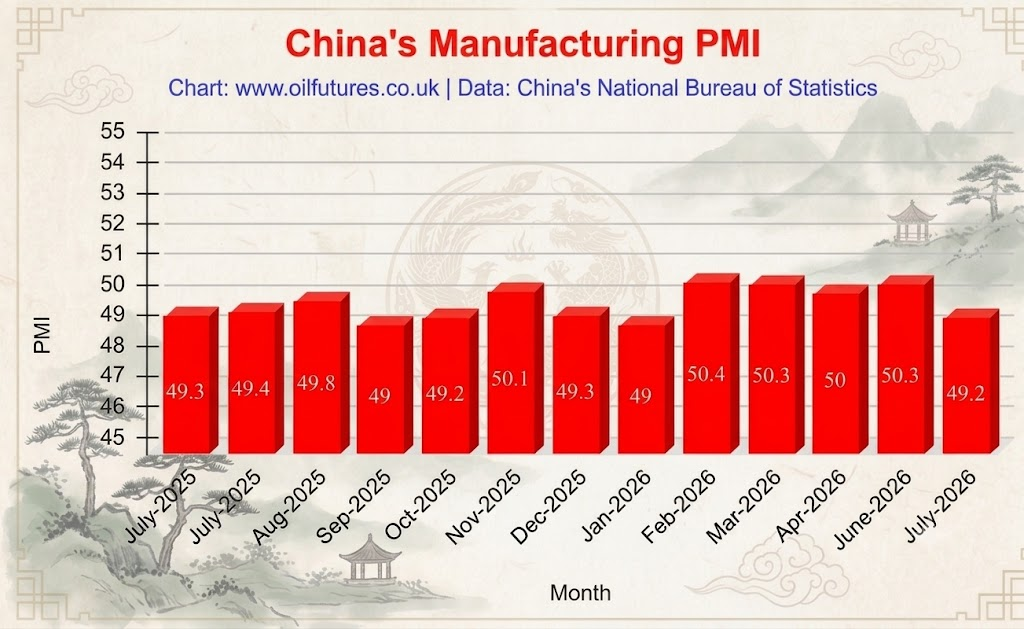

According to the latest data from China’s National Bureau of Statistics, the country’s manufacturing sector contracted in July due to a range of factors. China’s manufacturing purchasing managers’ index fell from 50.3 in June to 49.2 in July, registering a drop of 1.1 point. In addition, the non-manufacturing purchasing managers’ index fell from 50.2 to 49.0, defying optimistic forecasts by analysts.
The manufacturing purchasing managers’ index reflects the nation’s industrial activity. A reading of 50 percent serves as the threshold between contraction and expansion: a reading above 50 percent indicates expansion, while a reading below 50 percent indicates contraction.
Meanwhile, seasonal headwinds such as disruptive typhoons, flooding, and weak consumer spending added to the strain on the Chinese economy, causing a cascading effect that also dragged down the non-manufacturing index. Consequently, the composite purchasing managers’ index fell to 49.3 from 50.6. Under these circumstances, ongoing conflict in the Middle East provided little support for the world’s second-largest economy.
The war in the Middle East affected China in multiple ways. Volatility around the Strait of Hormuz disrupted oil imports, while soaring shipping costs and insurance premiums hit Chinese manufacturers hard. Chinese exporters faced reduced access to lucrative Middle Eastern markets, resulting in a significant drop in new export orders. Furthermore, importers faced difficulties sourcing certain raw materials through key maritime routes disrupted by regional conflict and naval security operations.
Although Chinese industries in artificial intelligence, hardware, semiconductors, and electric vehicles remain competitive against Western rivals, their ability to uplift traditional manufacturing remains limited.
As pressure mounted over the state of the economy, China’s 24-member Politburo, led by President Xi Jinping, convened for its mid-year economic review. According to state media, members acknowledged the pressing economic challenges but refrained from committing to a large-scale fiscal stimulus package like those deployed in past downturns. Instead, local authorities were encouraged to address sluggish consumer spending and funnel funds into rural development projects to spur growth at the local level.
Regarding energy consumption, China, the world’s second-largest oil consumer after the United States, drew down its massive strategic crude reserves rather than purchasing oil at inflated global prices. This strategy reduced China’s daily imports from typical levels of around 12 million barrels to approximately 7 million barrels in recent weeks to avoid overspending in open markets. However, this approach significantly depleted national reserves.

For global oil markets, China’s reluctance to purchase crude oil at elevated prices helped keep crude oil below 100 dollars per barrel despite Middle Eastern instabilities. China’s oil import demand remains a primary driver of global oil prices. Analysts will closely monitor upcoming purchasing managers’ index data to determine whether Chinese manufacturing returns to expansion territory.
