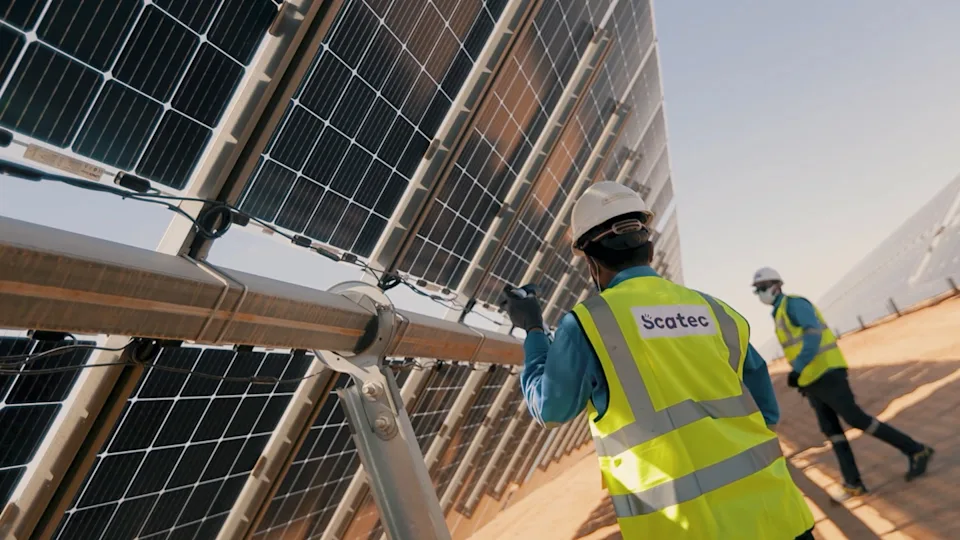
Mahmoud Esmat, Minister of Electricity and Renewable Energy, met with a delegation from Norway’s Scatec to review the operation of the first phase of the 561 megawatt (MW) Obelisk Solar Power Plant and the 100 /200 megawatt-hour (MWh) battery energy storage system that was connected to the national grid earlier this year.
They also reviewed progress on the second 564 MW phase of the plant, which is scheduled to enter service within the coming weeks as part of plans to add new renewable energy capacity during the summer.
Once fully operational, the Obelisk project will become Africa’s largest hybrid solar and battery installation, with an expected abatement of more than 1.2 million tons (mmt) of carbon dioxide equivalent (CO2e) emissions per year. It is projected to deliver over 3,000 GWh of clean energy annually, which will be supplied to the Egyptian Electricity Transmission Company (EETC) under a 25-year Power Purchase Agreement (PPA) denominated in USD.
The meeting also reviewed the implementation status of Scatec’s renewable energy projects in Egypt, with a combined capacity of 3.1 gigawatts (GW) and battery energy storage systems totaling 4 gigawatt‑hours (GWh). These projects span the governorates of the Red Sea, Qena, Minya, and Alexandria.
Among the projects reviewed were the 900 MW Ras Shukeir wind farm, which is to be connected to the grid in 2027, and a 1.7 GW solar power project in Minya.
Both sides further discussed plans to establish several grid-connected and standalone battery storage plants with a total 4 GW capacity in Minya, Alexandria, and Qena, as well as progress on a battery manufacturing plant expected to be completed next year with up to $1.8 billion of investments.
During the meeting, Esmat noted that the expansion of battery energy storage systems forms a key pillar of Egypt’s strategy to maximize the benefits of solar and wind power generation, particularly during peak demand periods and high-load conditions.
Esmat reaffirmed the ministry’s commitment to closely monitor and review renewable energy projects, both those already in operation and those under construction, to ensure adherence to scheduled grid connection timelines in line with Egypt’s target to raise its share of renewables to 45% by 2028 instead of 42% by 2030.
Moreover, Esmat underscored the importance of continuing efforts to upgrade the unified electricity grid in parallel with the addition of new renewable energy capacities.
Scatec, a renewable energy company, has been active in Egypt’s clean energy sector through a pipeline of solar and wind power investments. The company’s portfolio is anchored by its contribution to the Benban Solar Park, one of the world’s largest photovoltaic (PV) installations, and the recently launched Obelisk project in Nagaa Hammadi.
Source link