




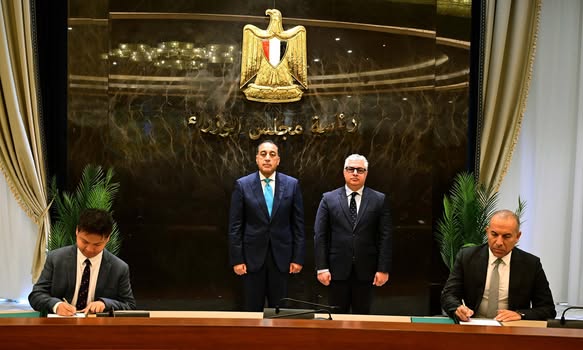
Egypt is set to host one of the largest integrated phosphate industrial complexes in the Middle East in the Suez Canal Economic Zone (SCZone). Al-Seweedy Industrial Development and CJN Company, the Chinese global leader in the phosphate industries, signed the deal to establish the complex in the presence of Prime Minister Mostafa Madbouly.
The major project, with targeted investments of approximately $1 billion across all phases, is located within the “Sokhna 360” integrated industrial city in SCZone on an area of 905,000 square meters (m²)
The project is expected to create around 10,000 direct and indirect job opportunities and will dedicate the majority of its production for export.
Madbouly praised the project, noting that it is a new addition to the SCZone’s successful record in attracting massive industrial projects in strategic sectors, according to a cabinet statement. Madbouly pointed out that attracting such investments aligns with the state’s plan to build an industrial base that enhances local production capabilities. Furthermore, it supports national exports, leveraging Egypt’s logistical potential.
Walid Gamal El Din, Chairman of the SCZone, emphasized that the establishment of this giant industrial complex reflects the confidence of global partners in Egypt’s appealing investment environment. He confirmed that the advanced infrastructure of the Sokhna area positions it as an industrial and logistical platform capable of serving regional and international markets.
For his part, Huang Chiu-han, CJN Egypt’s CEO, confirmed that choosing Egypt to build this complex was based on its logistical superiority and its massive raw phosphate reserves. He added that the conducive industrial environment provided by the SCZone, which can serve global supply chains at a competitive cost, was also a key factor.
The project is the company’s largest ever foreign investment in its history.
Phase One of the project, scheduled between 2026 and 2028, focuses on maximizing the value of Egyptian raw material by producing Phosphoric Acid and DAP/TSP fertilizers, each with a capacity of 300,000 tonnes per year. Following this, Phase Two (2029–2031) will center on producing high-purity specialized phosphate chemicals, such as purified phosphoric acid (PPA) for both industrial and food grades, which marks a product launch for the first time in the Middle East.
Finally, Phase Three, running from 2032 to 2034, will extend into new energy materials for the production of electric battery components. This final stage will produce materials like Lithium Iron Phosphate (LFP) for electric vehicle batteries, thereby enhancing Egypt’s position as a regional hub for the electric battery materials industry.
The project will also include establishing a specialised Research and Development (R&D) center, set to be launched concurrently with Phase One, to boost scientific research in phosphate-based chemical technologies and ensure the localization of the industry within the Egyptian market.
